Fred and Loathing on The Internet
Welcome to the public web log of Fred Lambuth
Popular Tracks from 2025-10-21
Settle Texas or Die Trying
2025-Oct-21
So far in the publication history of the blog here at fredlambuth.com we have talked about robots, big and small. We have blog posts mentioning samurais, superheroes, super-soldiers, super drunk hardboiled detectives, secret agents, stygian knights, seafaring pirates. There have been orks, space orks, and even space princes. What has been missing among this pattern is the cornerstone of boyish simplicity: cowboys and indians. Good guys and bad guys. The team here grew up in Western civilization, so it’s usually the cowboys playing for the good guys and the Indians for the bad.
Cowboys, by themselves, had in fact been written about in this blog. By way of the Red Dead Redemption games. The video game where I put in 100s of hours toward simulating the life of an outlaw cowboy. The kind of cowboy seen in Hollywood or Italian Western films of the mid twentieth century. Not the actual ‘cow’ ‘boys’. The video game was about robbing trains, playing poker, dueling with pistols, and the like. It was not about rural low lives who drove herds of cattle between ranches and railheads in the ol’ Southwest. Those cowboys would make a boring game. ( They do. I hated the ranching missions. )
Indians rarely appear in either of the RDR games. The bad guys in RDR, is the advance of Western civilization. A societal mass, with European settlers serving as a vanguard for the new way of life cutting into the American continent. The Red Dead Redemption games are indeed about the mythic American West; a land of untamed natural beauty sparsely populated by noble savages. Although by the time either of those games were set in(early 1900s/late 1890s), the only place to find an Indian was in a reservation. A place they were forced into. Instead the game’s landscape has oil wells, new and old gold mines, and logging camps clearing down forests for new railroads.
Once either of the RDR games’ stories started, the West was more or less closed. There were still plenty of wide expanses of unsettled land. Yet those vast expanses were not so unknown anymore, Not so dangerous despite still being so sparsely populated. What changed more rapidly than the amount of people migrating West were the train tracks and telegraph poles sending goods and information across that big mythic West.
The big money ranchers, mining tycoons, and railroads ventures had everything parceled up by that time.The geographical elements of the West were boxed up, ready to be shipped out on rails going East; to hit the ports and spread out these natural marvels to the rest of the world. The financial firms of the civilized realm were sending speculative ventures into the semi-tamed wilderness after the do-it-yourself settlers did the pioneering work. Those settlers also did the dying that comes with ‘settling’ an untamed land of natural beauty.
The notion that there is a savage unknown land that has yet to offer all of its secrets, or riches, was over. Whatever is out West, could be easily found in a mail order catalog by the end of the 19th century. Books upon books, with maps and illustrations, showed what there was to be had out West. The frontier was not so mythic anymore by the time RDR started.
One of those elements of the mythic West that had to be dealt with, rather than boxed up and sold back East is the hooting and hollering Indians. The noble savages sweeping across the open plains of the American continent. That was the ubiquitous way of presenting Indians in the Western films I saw as a child. Majestic riders of horses who disappear back into the wilderness as fast as they emerge from it.
Memorable as the movies made it look, those kinds of Indians were a flash in the pan of history. A demographic of people that existed for a mere hundreds years or so, with only a few decades in the 1800s filling out the tropes of what a Golden Age Hollywood Western Indian would look like.
That way of life on the North American continent, and most any type of pre-Columbian lifestyles except those found way up in the cold North, was wiped off the earth when John Marston or Arthur Morgan were dashing around as playable characters in the Red Dead Redemptions games. Those games took place at the twilight end of ‘the Old West’, in both iterations of the RDR franchise. The Indians you meet in that game have given up the idea that they could stop the white man’s way of life taking over their homeland. They are bygones, not a counterpart to anybody except any other past victims of Western colonialism. Certainly not fit to be the rival to any group of ‘cowboys’.
From what I remember, the only place you can find Indians in large numbers in the RDR game is on a reservation, where they look stationary and bitter. It was definitely a game that offered you a wide panoply of criminal goals and slightly less legitimate ones, with horses being how everybody got around, most especially the playable character. So those RDR games do offer a glimpse of the glorified idea of ‘cowboys’, not so much the ‘Indian’ part. They’re wonderful games that are better thought of as Grand Theft Auto games set in the early 1900s.
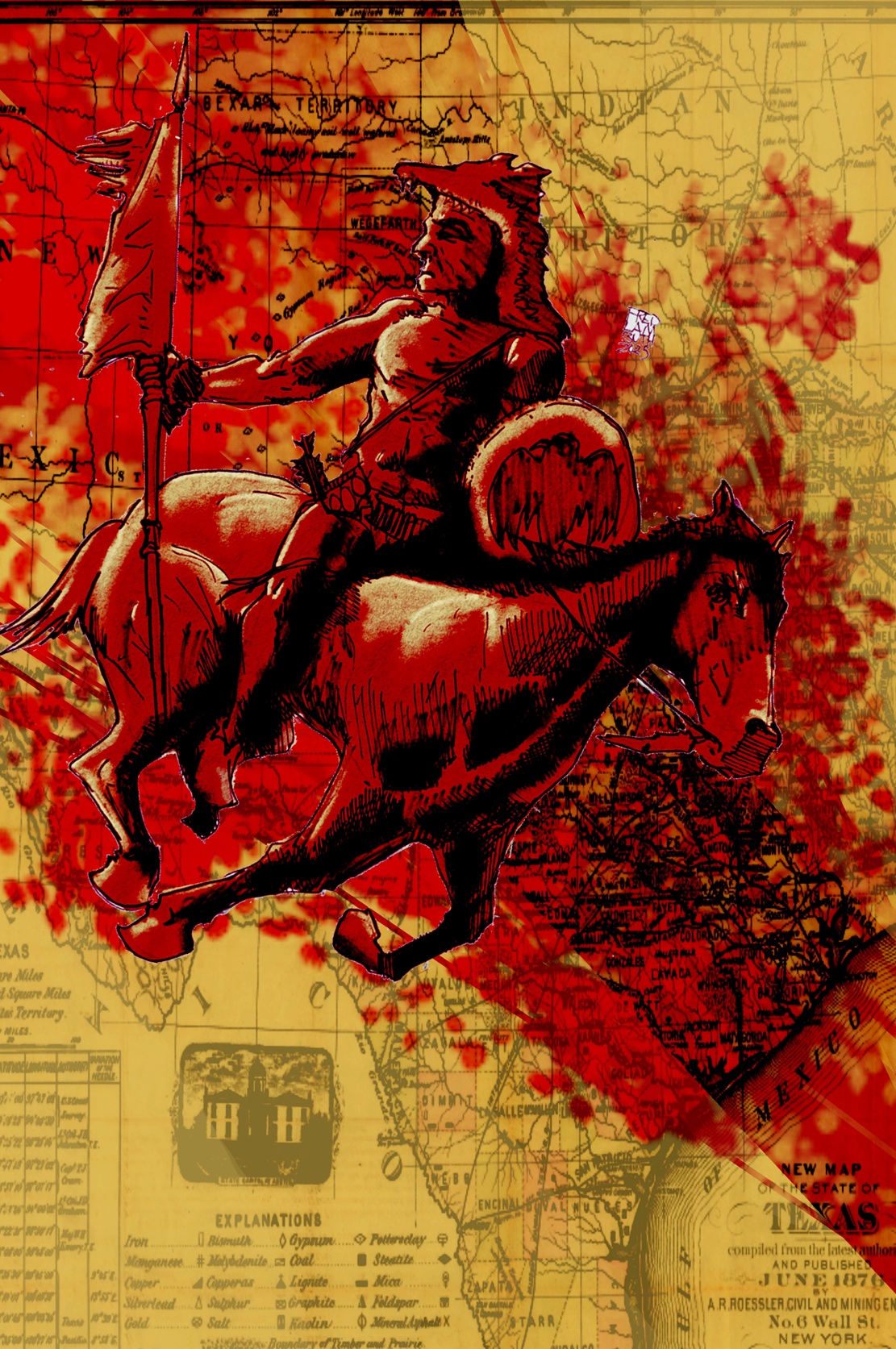
Well, providence has provided! The blog spirits have gifted us! The latest non-fiction book I read is about the most Indian of Indians, and the most cowboy of cowboys! The real ones that built out the legends that would spawn the Hollywood movies I watched. The Comanches and the Texas Rangers are what we’re talking about this time. The stable of childish paragons of this blog has another addition! I wonder what could be the next variety of childhood hero that finds its way here? Race car driver? Lion tamer? Tune in next time!
The book we are talking about today is Empire of The Summer Moon by S.C. Gwynne. Much like RDR, the cowboys in this book are the ones more often thought of as ‘cowboys’ rather than the itinerant laborers of cattle ranches that spawned the name. No, the cowboys in this book are not making sure herds of heifers get to their destination. The cowboys in this book are pistol packing, rough riding, Indian scalping types; Texas Rangers. These members of these ‘ranging companies’ would often meet most of the superficial tropes of a ‘cowboy’ established by Western films or Louis L’Amour novels.
These rangers, if their careers were long enough to let them talk about their exploits, were skilled horsemen, pistol marksmen (fired from a moving horse), and could live off the land. The ones who did not tell of their exploits died violently, and usually early into their career. Although these rangers make a splash in the story, they are a mere reaction to the leading role of the show: the Comanche Indians.
The Comanches’ unparalleled success at antagonizing the colonists pouring from the East makes them the star of the Wild West show in this book. Were it not for them, and other horse riding Plains tribes, the story of Manifest Destiny would have had a lot less violence. Instead it’d just be settlers in wagons dying of typhoid. And I suppose many more of them since there would be a lot less massacres to scare the settlers from trying their luck out on the frontier.
I suppose the frontier conditions would be brutal enough so that myths of ‘the West’ would still trickle down to becoming the classic Hollywood Westerns. Kurosawa's samurai movies are almost just that. Movies about rural frontier living that allows men of violence to get away with less than moral behavior. The kind of reprobates that take advantage of the great distances between posts of civilization, and the paucity of information between posts.
As much as the samurai and western films have in common, I think the ‘stranger in a strangeland’ element of ‘the West’ is what makes it a unique setting. One about more than the ease of committing violent crime in sparse levels of civilization. The Indians represent a way of life that is human AND part of a pre-civilized way of life. They represent the wilderness’s spoken wisdom. As something other than just a wilderness to hide out in until a return to civilized settlements. They are a way of life out there that does not believe in the inevitability of people huddling together into cities.
No tribes come close to these guys in their proficiency at slowing down the wave upon wave of white people encroaching upon the West. These Comanche Indians were the masters of the Plains ever since they mastered horseback riding in the 1500s. The Plains was the first geographic region where the Indians could stand their ground against colonists and their weapons tech.
Ultimately though, the waves of white people won. No matter how effective the Comanches could get at applying violence upon incoming white people, there were just not enough Indians and too many colonists. The Comanches scared away Spanish settlers, who used very small numbers of colonists. The Anglo approach was a rising tide of common folk willing to die for the chance of owning a plot of land. The Commanches, who numbered in the thousands as a total population, just could not kill enough settlers to scare them away.
Not only that, the white people stopped the Comanches by using their own strategies against them. These Comanche tribes were the last holdouts to an inevitable wave of Anglos. The Texas ranging companies that develop in response become just as sensational horsemen as the Comanche raiders. They became equals to the Comanches at fighting on horseback on the plains. This ability for the Rangers to ride horses, keep groups of horses maintained out in the Plains, or do anything at all with horses is what made the Comanches so spectacular. They geographically dominate an area that reaches into Canada to the North, the Rockies to the West, and the Mississippi in the East. The one tribe that could actually make a dent in the encroaching wall of white people that were the manifestation of Manifest Destiny. Curiously, the Comanches were said to be the dullest of the Native American cultures of the area. They were a people who wanted to acquire horses and win battles at all costs, and not much else.
I will admit an incredible bias towards Texas related things here among the editorial staff at fredlambuth.com. Hell, it’s easy to see we’re suckers for anything there is to do about Texas. There's just something about that perverse outlaw lifestyle that drives the state’s history jives with the editorial staff here. This book was a pleasure to review because of how much of the story not only involves, but requires the whole landscape of Texas. Texas is the reason that brings the conflict into this story.
Ultimately this book is about the greatest of the Plains Indians, but the geographic area that makes up the state of Texas today is where they first met the enemy that would end them, the endless wave of Anglo colonists showing up from the East, and their lowlife friends who were willing to heed the call of frontier settlers who said they might pay people to shoot Indians. That’s what did them in.
Among those nice settlers were so many good ol’ boys with rifles willing to give this Texas Rangers idea a try. The book makes it clear that most of them were rabble that accomplished little until some clear headed leaders evaluated why every military reaction to the Comanche raids were a failure. Once enough offensive campaigns were mounted with military organizations that used Indian style horseback riding, the Comanches were unable to be a threat.
The book ends where RDR begins. The last great war chief of the Comanches becomes a relatively and upstanding member of polite society. His story is fabulous enough that any mention of his life would only create more questions. The import of the end of his life was that he bought into the idea that Indians have nowhere to go but take what the white man is selling. I don’t blame him. Oblivion seemed like the only other option given.
Add Comment