Fred and Loathing on The Internet
Welcome to the public web log of Fred Lambuth
Popular Tracks from 2026-07-26
A First-Person-Shooter with High Explosive Holy War Hijinks
2026-Jul-26
This blog post will be logged as a ‘book’ critique in the current data model. In said data model, I believe there are plenty of secondary fields for categorizing each post. I have not built a web UI to add them, so rarely does a post get all those filled out. At this moment, each blog post gets one and only categorical bucket to fit into. Each blog post has to be mostly about one ‘thing’. Some days I go through the backend to reach that deeper data model, tagging blog posts directly with more than one category. Until then, this post’s singular bucket will be ‘book’.
The book getting the categorical spot is The Revolutionists by Jason Burke. A fantastic book. Recent publication. Fabulous, absolutely fabulous. The author did a fine job delivering an even handed report of the people perpetrating the airplane hijackings, rather than the causes that indirectly fed these radical acts. Had you not a firm awareness of the political hot button issues of the post-WW2 half of the 20th century, then this book would have landed like a 600 pages newspaper reporting on a decade of sensational terrorist acts.
The Revolutionists book offers a thorough chronicling of the vital players making a name by hijacking commercial jet airliners for political bargaining. The main political leaders in control of nations or of national importance are mentioned, and in great numbers. So once again, a familiarity with late 20th century geopolitical movements and escapades is recommended. The third act of the books chronicles the post-bargaining period of terrorism of the 1980s. When the achievement of the violence is the purpose, rather than a threat to be made if demands are not met.
In that 1980s era, when the hijackings or hostage takings shifted toward violence as a means in itself to cause terror, I was already well versed in the Middle East’s plight.
When 9/11 was a still ‘current’ event. I’ve read enough about the sacred-terror style terrorists that were en vogue. I picked up this book because I wanted to get a look at the sexy vanguard of submachine gun toting terrorists. I knew little of the prior era in the global war on terror. When it was rather one-sided until the authorities came up with a plan to deal with this glamorous phenomena in international crime. The ones who fought for any cause available, as long as it was against Western Capitalist Imperialist Swine. The target could be American, European, Israel, it does not matter. As long as it was not an underdog in the fight. An almost mythic age of rebellion when Palestinians took up arms with Commies.
We all know this blog is not the type to gush over some media object. One that is so obviously brilliant it does not need mentioned adulation. The Revolutionists is brilliant. Let's move-on to the main topic: a navel gazing snooze fest, staring straight down the navel of the blog and website’s progenitor. This blog post will be a word association test between the stimulus media and the mind of Fredrick W. Lambuth. In this case, the stimulus ( The Revolutionists book) has brought forth the associative idea of Counterstrike, the video game.
You guys might know it as its own video game. A huge success that has spawned several popular iterations. Jumpstarted competitive gaming. Implemented a cosmetic upgrade system that spawned a gambling system that could generate more revenue than the game itself.
Back in the day, it was just a mod for the pioneering first-person shooter Half-Life. It began as a modification to the Half-Life game’s assets, reassembled into a 5v5 PvP match. Back then, the late 90s, mods were a real hassle to get working. Bless the people at Valve for making the process so much easier. Funny enough, Counterstrike is the very mod that caused the need for Valve’s eventual final product: Steam. Counterstrike was so popular, it was in Valve’s best interest to make a unified platform to get everybody using the same files to play the mod. We could go on and on about the history of PC game distribution, but that would be too far down the navel. This blog post will only go as far deep as the terrorists versus counter-terrorist battle that is Counterstrike.
Counterstrike is a game of terrorists fighting counter-terrorists (elementary, I presume). Each team has five online players, working together as a team (hopefully) to achieve objectives conditional to the map. Sometimes the terrorists need to plant a bomb or kill a very important person. Sometimes hostages need to be rescued. Naturally the ‘counter’ terrorists need to somehow counter the terrorist’s objectives. They need to prevent the bomb from being planted, or the VIP being killed, or do their best to get the hostages to safety. Killing all members of the other team is always a winning option available.
A not subtle layer that differentiates the T’s from the CT’s in Counterstrike is the equipment available to them, and their visual models. Both sides receive no special advantage towards health, movement, or weapons accuracy. They play exactly the same in a firefight. The differences found between them are in the weapons available to each side and the surface layer of the player model.
The CT’s have a bunch of alphabet type special forces as their playable characters. GSGN. SAS. They have gas masks, stealthy dark fatigues, and modern armaments. The weapons available to them were modern looking stuff. Rifles with scopes, SMGs with suppressors, or any tactical gadgets in general. The MP5 or the M4 carbine being the sleek identifying weapon of the CTs. They looked to be the tip of the special forces elite spear. The product of being trained in the professionalized military of a developed Western nation.
The terrorists look like sharply dressed civilians equipped with an assortment of pre-modern automatic rifles. Weapons from the Soviet side of the Cold War. The AK47 being the most iconic of this side of Counterstrike. These weapons often are less accurate, bear archaic features such as a wooden stock, and bring a loud large caliber munition size.
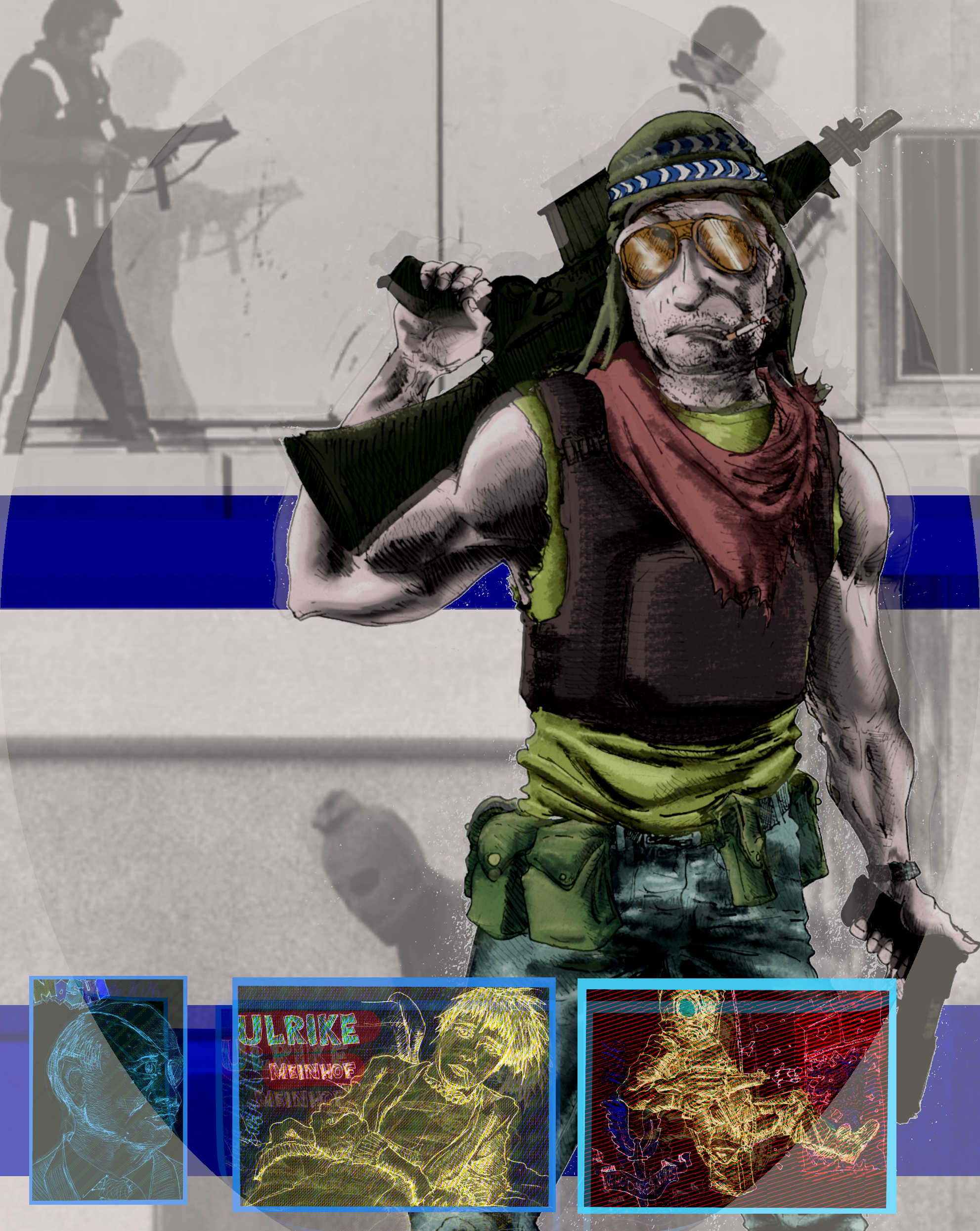
The race of the CTs is caucasian, as can be seen in what peeks through their full-face masks. The T’s are a more definite swarthy bunch of some brownish ethnic origin. As far as I can remember there were three masked characters on the Terrorist side. They were clad in semi-military attire. Black-and-white urban camo. Balaclava masks. The one that stood out among the four was the one wearing passable civilian clothes. With a button-down shirt, sunglasses and snazzy haircut. Had I to venture a guess as to who the modders were inspired by to create this Terrorists playable model, I would say Carlos The Jackal.
Carlos The Jackal plays a juicy role in The Revolutionist. I say juicy and not pivotal because there is not exactly any pivotal character in the story of the ribald Islamo-Marxist terrorists fighting the Western capitalist nations, and the elite squads of professional soldiers formed in response to the galling acts of international terrorists.
Both teams on Counterstrike exude a romance to their plight. The terrorists look like the dashing dilettante freedom fighters of the 1970s. A broad multi-ethnic alliance brought together solely by their antipathy for Western capitalism, and their ability to cut a dashing figure when holding firearms. Each of the four character models look like hardened semi-regulars in a military fight. The one slick looking dude in the shades could be one of the Germans who attended a few terrorist training camps among Palestinian fighters.
The romance for the counterterrorists of Counterstrike is the chivalric quest to defend a good society from barbarians. The best of the best a nation’s professional army can offer. A cadre of well-equipped elite soldiers thwarting threats to their righteous homeland.
The Revolutionists digs deep into the details of the broader geopolitical story that created the concepts and the cutting figures that came to be included in Counterstrike. The settings of the books spelled out the same setpieces that could be found among the first edition of maps of the mod. The plane on the tarmac hostage mission, the Italian cafe bombing, or the rooftop helicopter exit. These levels were settings for real life terrorist acts that sometimes got thwarted by military or police units trained to act against these new terror situations. Ones that are soft police targets yet require overpowering military power.
In the game the CTs are always there, ready to respond to just these situations. The lesser spoken about side of The Revolutionists would be those CTs squads that were created in response to terrorist threats. This has whetted my appetite for a more close-up look for those first generation of special warfare operations. They usually are championed by the weirdos of the military. Some that can get as weird as the glamorous Islamo-Marxists that they hunted.
Were there a main character to the book that could not be ascertained simply by playing Counterstrike, it would be the nation of Israel. Jeezus Christ, Israel is the axis about which this book turns about. Page after page, somebody has it in for Israel. The Muslims for displacing the Palestinians from The Levant, the USSR doesn’t like them because they sided with the US and its allies.
Marxism comes in as distant second place as the other unseen but powerful force in this time of history that could not be absorbed through the visual design of Counterstrike. I found the ‘anything goes’ diversity of this era of the book more enthralling. By the time of the conclusion of the book, religious terrorists are a dime a dozen fighting Western nations. Marxists ones became quaint throwbacks. Almost kitschy.
Add Comment