Fred and Loathing on The Internet
Welcome to the public web log of Fred Lambuth
Popular Tracks from 2026-04-30
Bugged By Feelings
2026-Apr-30
New TV series are rare for me. Has been that way for at least one or two decades. There is just too much investment to get involved in a show. Good ones or bad ones. At least with bad ones you don’t sink any memories into them before letting go of them. That is if you are wise enough to quit before you know it's not going to get better. Who has time to take that risk? I just drop a show if more than three episodes hold me through. Often even less. It’s a poisson distribution close to 0.
One season of a bad show, or a few half-baked attempts at watching a whole season, can demonstrate to you what is lacking about them. What the good shows have and what that dreck did not are hard to notice if you exclusively seek out ones that please you instantly. Sometimes you gotta push through television programming that displeases you. Or into mediums that aren’t your favorite yet it offers something up your alley. Big robots fighting big anything is up my alley. Any medium should have an easy task ahead of them if that is the subject they’re working with.
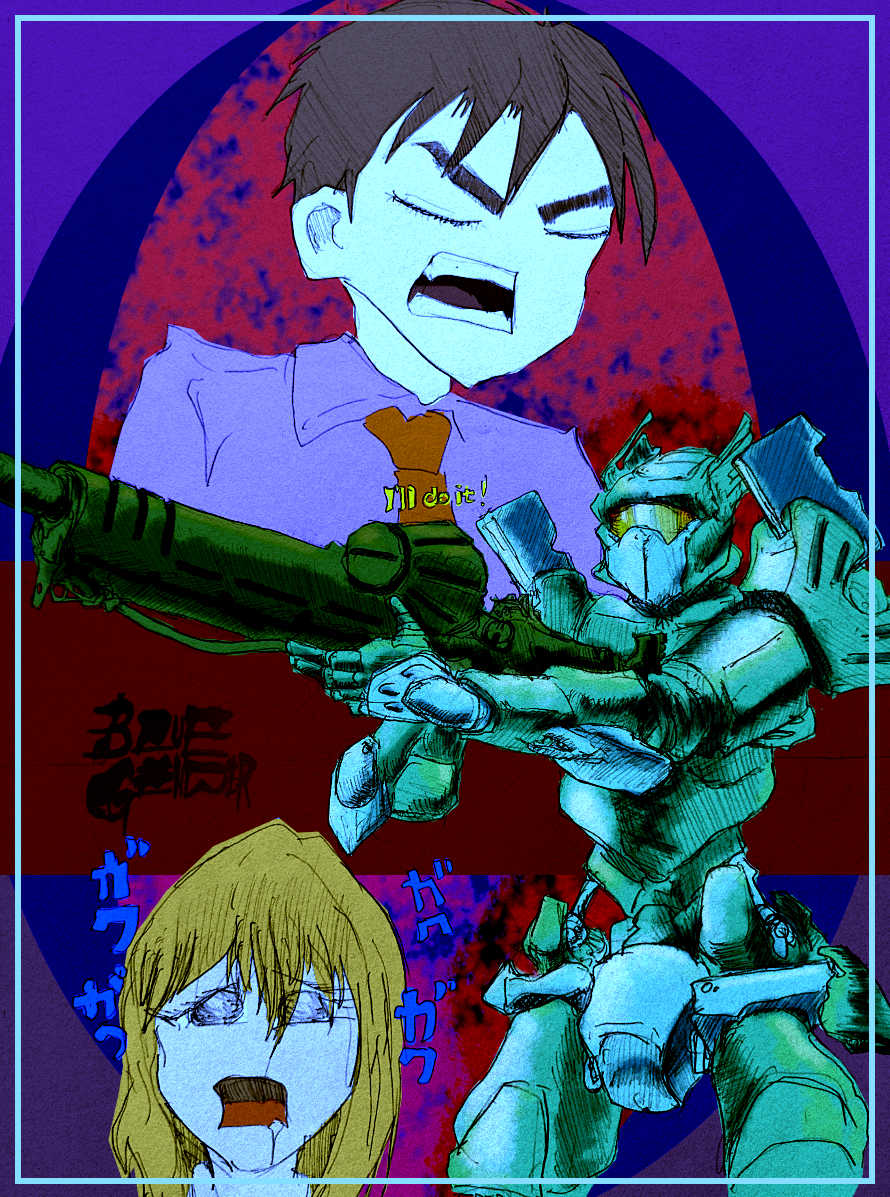
The TV series that I gave an honest effort to enjoy and then wrote about it here will be: Blue Gender. Sounds a little gay doesn’t it? It’s an anime from the late 90s. From an era when gender wasn’t so directly a LGBTQ buzzword. It's hard to tell why it is called gender at all. Blue is used dozens of times per episode (it’s the name of the show’s space bugs). The gender in the title probably has to do with the on-screen physical romance. More than I have ever seen on a show about big robots fighting big alien bugs. It got racy a few times. On the same level as a teen romance show, or a young adult novel.
Hey, there was a sex scene in the Starship Troopers movie that was released around the same time as this anime! A somewhat surprising directorial choice at the time, in my seventh grader perspective. I wonder if one influenced another. Or this is a case of great minds thinking alike. That is not to say I think that the 1997 Hollywood adaptation of Starship Trooper or this Blue Gender anime series are great, but I did just realize that it is also a humans vs space bugs story.
Paul Verhoeven is definitely capable of greatness, and so are the animators of the fights on Blue Gender. I do think Paul Verhoeven was very enchanted with the idea that the young are the ones fighting the war in Starship Troopers. Blue Gender is ripe with romantic and sexual melodrama because the ones piloting the big robots are tempestuous youths.
There was no sex scene in the Starship Troopers book. I haven’t read the thing since my teenage years. I do not recall there being any women among the mobile infantry. I do remember the pilots were all or mostly female. I’ve thought about reading it again to see if the book is as obviously fascist as Micheal Moorcock and Paul Verhoeven felt on first impulse. I’m not that perceptive, so I’ll have to actively put every sentence through the scrutiny of a homoerotic fascist lens. I believe Moorcock runs that way on autopilot.
The original novel was an excellent foray into the genre of big robots vs big bugs. Prior science fiction novels would have tales of human military technology against non-humanoid aliens. Often though taking a more space opera detailing of the story alien conflict. Starship Trooper was redoing this same basic idea, this time with the human military fleshed out by an author with a joyful experience in their short time with the WW2 era Navy. Starship Troopers, published in 1959, was Cold War logistics, strategies, and tactics of the 1950s buffed up with space age weapons, fighting bugs in space. Not a romantic raygun romp. It was mess decks, muster, deployments, and watch standers.
That is so clearly not the case with the Paul Verhoeven film. That screenplay is about humans flinging themselves light years into space to fight bugs. Not much else is shared. What it does share more with Blue Gender than it does with its source novel is the young adult romantic melodrama.
The film did have all notable characters fresh faced youngsters. A few authoritative colonels and staff NCOs to round out the Saved by The Bell in an intergalactic bug war feel the movie gave off. Verhoeven might have been on purpose making this teenage drama tinged type of story, foregoing the military realism of the novel. Instead, putting attractive youths dying for old men as the meat of the story.
Blue Gender themes got a little lost on me in the latter half when the old men who are eager and willing to sacrifice youthful soldiers showed up. They did state out loud their reasons for why they were so cavalier with the lives of their young beautiful soldiers fighting the big insects. My interest in the show had become vacant by then. I think plain ol’ hubris was their flaw. Old men not listening to the youth about how to solve their apocalyptic problem.
Whatever incredible satire this Starship Troopers movie achieved in pointing out the hidden facism of the society in Heinlein’s novel, it will always carry some sting to it because of how chintzy the movie looked at first glance. The news of this movie’s production prompted me to actually read the book. My father lauded it several times over. I wanted to get an expectation of what the movie got right or wrong from the book. Back then reading the book before the movie came out was the thing to do.
Reading through the book became exciting when holding the expectation of seeing what the book described was going to be made real with the magic of mid 90s computer graphics. At least half of the book got done well enough. The bugs looked cool. Enough.
I hope for some artistic vision other than budget constraints, the movie Starship Troopers has the esteemed mobile infantry from the book to be a space faring unit that fights intimately close together, firing 7.62 mm rifles one 30-round magazine at a time, and coordinates their movements with vocal commands. The absurdity of seeing faster than light starships importing in some unarmoured light infantry divisions on a distant alien planet was jarring even to my middle school mind. I would guess that having the mobile infantry as mechanized as the book described was still out of reach for Hollywood special effects budgets in 1997.
I could have ignored the vocal commands. Trying to get the audience to understand what is happening in a complex battlefield would be hard to convey without committing to some special effects to do the job. I could give in to the idea of not using environment sealing helmets on an actor's face. I wanted to cut so much slack for the sake of easy screenwriting. What I didn’t like was the basicness of the weapons. So utterly basic. The book promised so much. At the very least, better weapons than what was available to defense budgets in the 1990s. Couldn’t those grunts have plasma rifles? Just something other than what NATO troops were using in 1997?
Blue Gender is a notch in the pantheon of space marines vs space bugs, nominally. There is a story of humans using augmented mechanical suits to fight bugs. Blue Gender has much more in common with anime than with my favorites among the mechs vs bugs genre. Or with a lot of other genres. The ‘armored shrikes’ were mere anime trappings rather than an interesting feature. The ‘well designed’ impression I had wore away everytime I saw an ‘armored shrike’ with a cockpit that exposed the pilot.
To my best recollection, I never knowingly watched one episode of Blue Gender during the original programming block. I was glued to the Adult Swim programming block in the early to mid 2000s. A good two-fifths of that block was dubbed anime. Anime was just not my thing back then. Had there been more actual mecha versus bugs instead of melodramatic shouting, I might have more memories of its original broadcast.
The reason why I think Blue Gender sours me despite the trappings of big robots holding big rifles shooting intricately animated megabugs is likely because the writing was pointed toward an audience of Japanese teens in the 90s. There are hardly any visual anime cliches on Blue Gender. The first episode not having even one example of those was what convinced me to try this show out. I’ve only seen a handful of anime that kept it one hundred percent without any anime visual cliches. Visuals aside, the writing is oozing with teenage angst.
After a few episodes the melodramatic writing and pacing that I often do not like about anime reared its ponderous head. There were 28 episodes to the series which could effectively be trimmed down to 14. Simply by making each shout and pregnant pause not so long. Making running time cuts like this would keep all the relevant plot. It would have less brooding, but maybe that stuff is part of the show’s appeal towards 90s Japanese teens.
Most characters either whisper or shout. Calm or exuberant. Especially the moody main character. They even made his moodiness a crucial part of the plot! Super moody protagonist aside, the acting bounces between calm and loud with little wiggle room. I suppose that could be just a case of translation rather than a problem endemic to anime.
Anime is still not a big draw for me. At least not anything more than any other type of TV series I can get from the library. What Blue Gender has (big robots, big bugs) might have persuaded me back in the 2000’s to watch had I known of the big robots and big bugs. Well designed ones that are supposed to be fighting each other on a near per episode basis.
The bugs kept consistently getting more impressive. Although the series ended with the cliche of having to kill some big ‘perfect’ bug to save the day, each bug was pretty cool looking. The robots stopped looking like pieces of modern military in the second half of the series. Then more and more like mecha in any anime. Sleek ones that fought with melee weapons.
Blue Gender has been a case of disappointment. There was promise in the beginning. The answers became deep if you were fourteen. The luster of its military robots faded quickly. What you have is twenty eighty 30 minute episodes of increasingly designed scary bug titans.
Add Comment
eddie_from_chicago
C'mon chief. The conclusion on this post goes nowhere. I can't believe the editors let that slide.
2026-06-02 20:38:53.635725