Fred and Loathing on The Internet
Welcome to the public web log of Fred Lambuth
Popular Tracks from 2025-09-13
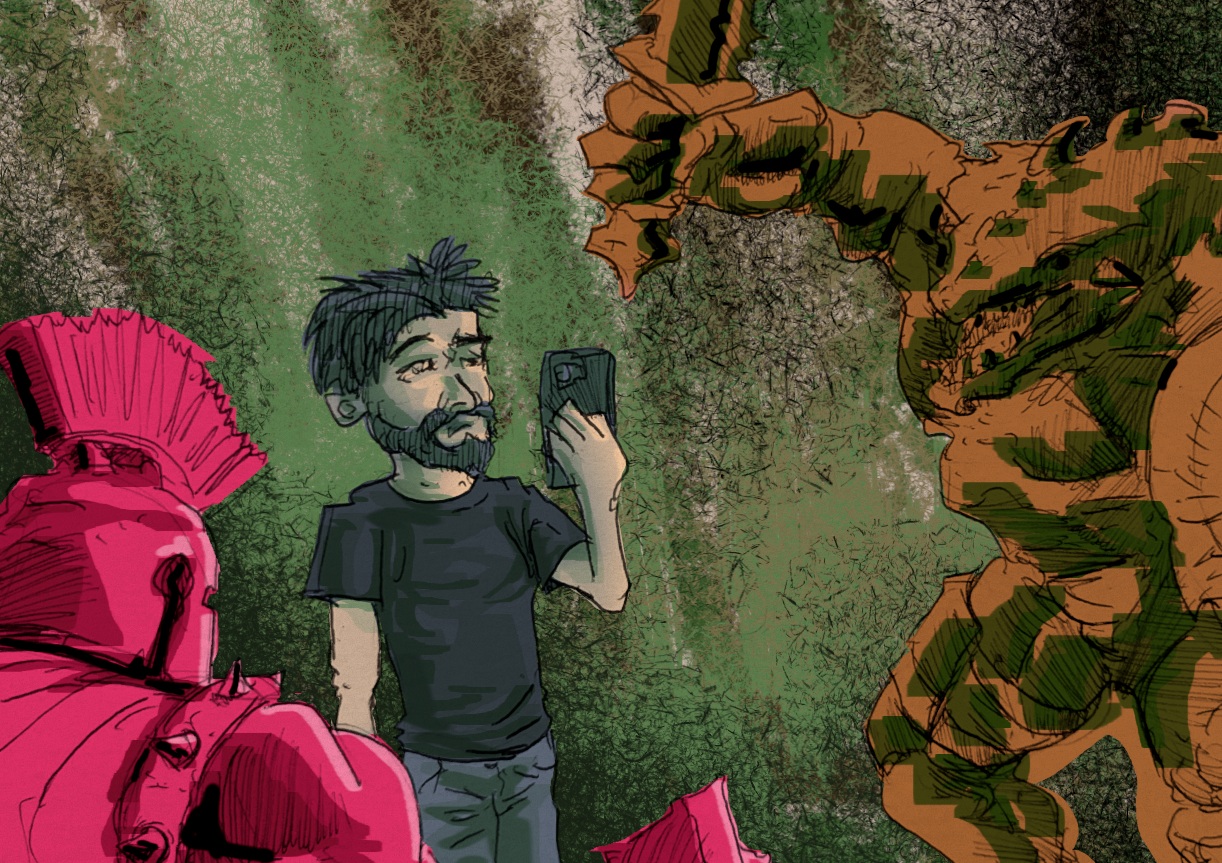
My Figures Are Supposed To Be Painted That Way! That's Battle Damage!
2025-Sep-13
The big topic of this blog post is Warhammer. If you’re an adult who’s made it this far in life without hearing that word before, I’m sure you might be thinking of an actual hammer. A real mean-looking one. A hammer made for war, perhaps. A mace, flail, morning star, knout, or even a shillelagh (that’s an Irish fighting stick with a bump at the end). Although I’ve spent decades enjoying the secondary fruits of why Warhammer exists, I can’t say for sure why it’s called that. There’s practically a religion written underneath the Warhammer lore, but no hammer I can think of.
Not once have I thought of an actual physical hammer of war when hearing the word. In recent years, when reading nerdy websites about nerd gossip, I saw mentions of characters in Warhammer Fantasy rallying around a hammer-wielding protagonist. I think a hammer-centric logo was being pioneered around the same time. Whatever the case, I’m not that kind of Warhammer fan. Definitely not a Fantasy type.
Around the time I first heard of Warhammer, I was about nine or ten. Everything marketed to me at that age had the word “war” or “battle” or “soldier” in the title. At the very least, something martial sounding. In the very same mall hobby store where I first saw the tabletop game “Warhammer,” I also learned about “Battletech,” a competing tabletop war game set in the far future.
The “war” part was the prime word when I first heard “Warhammer.” It’s still the emphasized part whenever I put “Warhammer” into a sentence. (What is that hammer?) The components of Warhammer sounded amazing before I could remember the official title describing the cool stuff. It was about demons fighting knights or space marines with very intricate designs for all the playable armies. This world wasn’t bland knights fighting bland orcs like in any run-of-the-mill fantasy role-playing game. No, these were overdesigned, anti-hero knights fighting even more overdesigned Chaos beings. And the orcs are Orks! Orks! Orks!
To my mind, Warhammer offered the choose-your-own-fighter magic that Street Fighter 2 first showed me a year or so before. You pick the fighter—or in this case, the army—that looks the coolest, then you learn the moves to play with them. But not too many to choose from. Enough to find two or three you like, two or three you dislike. Maybe build a rivalry against those characters.
40k was a more memorable tag than Warhammer in my memory. 40k was a bold novelty. To grasp what life could be like forty thousand years into the future. Never heard of Warhammer? 40k means nothing to you? I don’t blame you. It’s a very, very nerdy idea. An expensive one when done right.
Very intoxicating. I suppose only for the nerdy at heart. The revenue-making heart and origin of Warhammer is a tabletop game played with official figures (and a lot of dice) produced by Games Workshop, a British company that has been in the tabletop figure+lore business since the ’80s. In what state the company is now, I do not care to find out. They often sound like short-sighted jerks.
What is a tabletop game? I suppose it deserves a terse explanation. In this case it means there are tiny plastic figures representing single characters with the ability to deal damage and receive damage. Warhammer Fantasy and Warhammer 40k use the same set of rules, letting at least two players manage the movements of their units against other players’ units.
It’s possible to just get the rulebooks and make some bottlecaps represent a conventional squad of Space Marines of Imperium of Man spearmen. Officially, it should be done with the official rules and official figures, brought to you by Games Workshop. It would be wonderful to play a video game version of Warhammer 40K. However, Games Workshop would lose its raison d’être. I don’t exactly blame them for never creating a more convenient but less profitable version of their game.
To me, Warhammer is a property old enough—and built by the hands of so many creators despite each one being an employee of Games Workshop—that it ought to escape the surly bonds of Games Workshop’s intentions. At least as far as the lore goes. The stories, characters, aesthetics, and vices of Warhammer are a literary subculture large enough to have outgrown the stated whims of one company’s direction. IP ownership be damned.
I find Warhammer to be like Superman: an idea that belongs to the people and not to the current owners of the intellectual property’s ability to collect profit. Although I don’t wish to dive into the politics of contemporary Warhammer tabletop fans. The company is contemptible for obvious profit-seeking reasons. The fans on the other hand are twisted by the game's aesthetics. Especially among the people fielding human armies. I bet the Dark Eldar types are the cooler players.
To be frank, I’ve not played the tabletop game once. Not once. Never painted a figure. I’ve witnessed less than twenty minutes of total playtime of other nerds across the many years of my enjoyment of the idea of ridiculously bulky Space Marines fighting interdimensional corruption with big guns, out in the far reaches of space.
I’m stuck between worlds in the Warhammer world. I love everything about 40k, yet don’t have the nerd gusto to assemble all the costly and time-consuming parts needed to play the actual tabletop game. A game that is essentially toy soldiers. Really, really cool-looking ones.
I can only muster enough nerd effort to play dense video games that distill a lot of the war in Warhammer into a condensed version available to beefy PC owners. As of this point, the Total War flavor of Warhammer only works with the Fantasy stuff. There are no 40k strategy offerings. There are some 40k strategy video games, or so I’m told. My taste for learning a bunch of new video game rules at this point in my life is pretty close to nothing.
The big game changer about Total War making a Warhammer game was that it meant real-time battle! Everything on PC and 40k strategy had been turn-based. Yeah, I know about Warhammer: Dawn of War 1 and 2. I don’t like to mix base-building and fighting in the same RTS. That’s probably a blog post on its own explaining those nuances. The video game caveats I have are almost as nerdy as the work needed to put one single 40k squad into playable condition.
How cool they look is part of the subculture. Dawn of War and Warhammer offer some level of customization. Nothing compares to what can be done by a skilled artisan using—mostly—official figures. Deep down I knew I wouldn’t have the patience to create a decent-looking army that wouldn’t infuriate me after many rounds of playing. Especially if I was losing with them.
Never have I mustered the cash or will to spend weeks putting together my first playable squad of Space Orks or Space Anime Robots. Instead, I spend an equal amount of hours playing iterations of the Total War formula. As of late, I’m sixty-ish hours deep into the third Total War volume of Warhammer. Prior to Warhammer getting a Total War game, I was already down with most anything Creative Assembly made—since their first game Shogun.
Total War: Rome was my first dip into the no-base-building style of real-time strategy. Instead of starting from scratch at each round, building up the quickest army you can to start fighting, Total War starts with a big fighting army and ends with at least one army running away. Usually because they suffered more casualties than the other army. That game was one of the first to show me how a smaller army could win a battle by breaking the morale of a larger one.
In between the battles is what makes Total War games hypnotizing. The battle system is my preferred way of playing with video game toy soldiers. Alongside it, Total War games usually have a deep enough strategy layer connecting the battles together. A larger game map of symbolic pieces representing a whole corps of weird combatants moving across the landscape, which is itself littered with fantasy landmarks such as titan’s bones or haunted cathedrals.
That strategy layer is what compelled me to write this blog. It’s the turn-based element that gives me the same intellectual tickle that Civilization games give me. This blog is a stopgap measure to slow my video game consumption. An artistic testament to show I’m not spending all my damn free time playing the Lizardmen campaign over and over until I get it right.
This third time around I think I’ve found the zen of using the Lizardmen. This latest time has me starting next to the Cathay army. Their flying units are really annoying, but still manageable. Especially if you prevent them from having flying units! I hope once I finish this campaign, I’ll be able to put this game down. Go find another waste of time.
Add Comment